Mind control is very real. This article is not for the type of skeptic who sees the evidence from a laboratory as divine and "if p then q, p, q" as metaphysical nonsense.
In other words, I'm going to tell you how it works, I'm going to tell you why it works, and I'm going to give you a yet-to-be-seen metaphysical proof for its existence and power, without providing a single peer-reviewed article. Please enjoy.
And please read the article. Otherwise, it will not make sense to you. I'm going to make it as nice and simple as I possibly can, just for you.
MIND CONTROL. What does it mean? As I will explain, it's not what you think. To start this explanatory process, we'll begin with the first rule of my metaphysic:
1. No ego can be coerced.
We're not talking toaster waffles here. And we're not talking about coercion with guns, either. An ego is what you are. It's what I am. For those who don't know, metaphysics is entirely concerned with the nature of being, so we're going to get down to the nitty-gritty details.
What are you? Are you your body? - head, arms, legs, hands and feet? Or maybe you are your brain? - all the neurons and particles that make it up? Tell me, what if you lose an arm? What if half your brain is surgically removed from out of your head? (Yes, it has happened.) Are you still you? Of course you are. What else would you be? :)
No, you are not your body, nor your brain. You are a perceiving, thinking and acting entity. You are an atom, in the Greek sense (something that is indivisible). You do not exist at a location, you exist outside of space. You are not perceivable, not thinkable, and not coercible. In other words, you have existence and a volition that is only yours.
2. No ego can be visualized.
You can not be seen, smelled, tasted or touched, and you cannot be visualized. I can visualize, "in my head" (but not really in anything), your body, or your brain - but I cannot visualize you, nor can you visualize yourself! This is because visualization happens in space - a person's mental space (which, as I will explain, is all the space there is) - and you are not in it! This will become very important later as we discuss what properties make something a creation (hint: being visualized is a big one.).
This should give some insight as to why no ego can be coerced. You can force the movement of my arm, but you cannot force the action of my will. You can move my body, but you cannot move me. After all, being outside of space, I don't move.
I'm sure there are a bunch of questions popping up in your head right now, least of which: "how is this relevant?" All I can ask is that you be patient - all will be explained.
3. All things are perceptions.
Allow us to consider the nature of things. A table, for instance. What makes up the existence of the table? You see it, you feel it, and you can perhaps smell or taste it if you wish. In other words, it exists as sensations. Seeing, feeling, touching, tasting and smelling are all perceptions, and the table is ultimately reducible to only these. If it were reducible to something else, you would not perceive it, and it would, thus, not be an aspect of the table.
4. There is a dualism of existence.
Now, I say things, but I categorize these as being outside the category of egos, which are not sensations. Egos cannot be reduced to any simpler form (thus, an "atom."). Here we acknowledge a dualism of existence: egos and things, or, egos and perceptions (or sensations). No sensation is reducible to "ego" and no ego is reducible to sensation (it is an entity of sensing). They are wholly different.
Just to get this straight, remember that your body is sensations, while you are an ego. That means that you are wholly different from your body.
5. The world was created by an ego.
As you can easily attest to, the ego may produce thoughts "ex nihilo" - from nothing. Just as you can visualize a table, so other egos can create objects in space. But there are two great differences between your visualized table and the tables you do not visualize. The latter are of a far superior quality, and they also are not of your making. But that does not mean another did not make them. Indeed, a far more powerful mind than yours - a God, we'll call this creator - produced from his thought the tables you see just as you produce tables from your own thinking. There are two ways we know this, and several very important implications that result.
In philosophy, there is a well-known problem of induction proposed by David Hume in the eighteenth century. It states, and correctly, that a knowledge of the present and past does not provide a knowledge of the future. Quite simply, that the apple has fallen from the branch a hundred times before has no bearing on whether or not it will fall an a-hundred-and-first time. And yet, we do predict the future, and are quite successful. We know things about it. The explanation is also simple: God, creator of the things we see, keeps them constant such that we can apply our own interference. Without laws, which are not necessary, but constant by the will of God, we would not be able to use our agency in ways conducive to our own progression. Thus, as we only ever have the past state of affairs as a basis, God establishes the law as a Schelling point by which man can predict the future. (Those more interested on the subject are welcome to talk to me further. I would recommend learning about Schelling points first. :) )
If the world were of a random existence, we could not establish any reason for its staying constant. We would be at a total loss to predict any future event. The problem of induction would literally destroy all inductive reasoning ability, and we would be lost in void.
Furthermore, knowing that the ego and things are of a separate fundamental existence, it is altogether impossible that the happenstance would so arrive that perceptions are made perceivable by various beings, all of which are granted the same perceptions. There is no "link" between your mind and mine - that we both perceive the same things is surely by virtue of an intelligence which desired it.
6. Thought imposition is necessarily possible.
And now we begin our steps toward mind control - first by acknowledging that which God has done to us. God has not only produced visualizations of extraordinary vividness - he has imposed them on your mind and mine. He has visualized His thoughts into our own mental space. God is no fundamentally different from you and I - he is an ego - one that acts, thinks, and perceives, and is relatable to us, building an entire world for the sole purpose of our own progression. This entity, of a fundamental nature no different from you or I, can impose his thoughts into the mind of another.
Can we do the same?
There is no proof that extends further than this, except by your own experimentation. As it happens, we can. Telepathy is the simple process of two egos imposing thoughts in each other's minds, and it is completely doable.
So, what about mind control?
Mind control is no fundamentally different from telepathy. Indeed, it is telepathy - but with a notable twist. Most minds happen to be in a state of total pandemonium. Most people do not have a direction for their lives. It is when you impose a thought as a mind quieter than theirs - as a mind that is obviously purposed and with direction - that they assume it to be a thought of their own, but an extraordinary one, and they obey, without consciously knowing why. This is mind control - an awesome responsibility, with as much potential to do harm as it has to bring great reward. But I extend it to you as an option.
Here is how it is done: visualize a funnel above your body, or above your soul if you can so manage. Visualize another funnel above the body (or soul) of another. Make your mind exceedingly quiet. Now imagine your thought being produced from your head, and coming out of your funnel, then place it into the funnel above the other's head. Watch the results. Keep in mind that the thoughts are not literally entering another's head - as we have already discussed, they are entering the mental space of another entity that has no location, and whose space is inaccessible to you. You are forcing your thoughts into their space by visualizing something meaningful that connects to the understanding you currently have. You must be persistent. The mind grows stronger with practice.
Again I say, mind control is a great responsibility. I advise those who practice it to bear in mind all appropriate ethical considerations, while making sure to have an extraordinary time.
Blessings!
Showing posts with label My life. Show all posts
Showing posts with label My life. Show all posts
Monday, January 13, 2014

Thursday, January 2, 2014
The Kingdom of Truth and Love Explained
It is the belief of some men that life is better suited under conditions in which he strives for a more ideal knowledge - that is, a knowledge of things as they most directly relate to his well-being. One could contend that the idle chatting of the common man is sufficient for this cause - that speaking in terms of women, boys, clothing and food is all that is needed for our greatest happiness, but many of us think differently.
I contend, and by this contention hereby state the existence of my kingdom, that man is best-suited to ponder that which defines his existence. He is best-suited to think of what he is, what he can do, and what of the universe that binds him to things he does not understand. He is best-suited to stretch his boundaries of knowledge in ways entirely abstract from experience - in aprioristic ways, i.e., in those ways which are not related to the outside world, but to thought alone.
Consider that man does not know his true nature - I say this to the metaphysical idealist, or to the dualist, or to the man who believes he is ego - non-physical, but spiritual, or to he who acknowledges the impossibility of the statement: "I am my body", when in fact the faculty of his perception denotes the meaning of a being far greater. Consider that for all his uniqueness - his strange functions and powers when compared to the things he observes, these being his ability to observe, to think, to conceive and comprehened, to act - that for all this, man craves the material as though he were friends and equal peers with its nothingness, its dust-composition. I speak to the man whose bosom boils with that feeling of his superseding the temporal and mundane, to he who screams in agony at the thought of acquiescing in mere finitude - to he I say: join me.
The kingdom is a forum for discussion. It is a means to enlightenment, or to progression, or satisfaction in knowledge, to the man unsatisfied with his cognitive lot. It is a means for establishing a higher end, and then pursuing it by logical discourse. It is that medium by which men become gods - and one of many, but one nonetheless, if I do say so myself. The great compliment comes not from arrogance, but from acknowledgment in that possibility, and from the optimism that things get much better the much harder one strives. It is that driving optimism that leads me to the establishment of a kingdom for the like-minded.
Which is not to say the kingdom is for alone the theistic metaphysical idealist like myself, but for the man, who like myself, is of the mind that he can progress with the aid of his own thoughts and those of others - the man who believes this is purposeful, useful, and possible. To he I say: join me.
There is no commitment, there is no obligation, there is no binding force, there is no dictator, there is no leader, there is no establisher of say-so - it is the anti-cult, and not that which so many ascribe to it merely on the basis of its name. That name serves to promote the seriousness of the concepts it seeks - and be there other concepts to arise from the mount of knowledge shared, they would be ammended thereto were it not for the complications and confusions of an establishment's name-change. To those so infatuated with those ideas as I, and to the other noble virtues and values that make up man, to he I say: join me.
By any messaging - a comment here, a facebook message, an email (jacob.oveson@gmail.com), a text message (7203944411) - it is irrelevant by what means I am notified - by any such attempt to seek the truth through this medium, I will respond with a 4-page document of questions. Feel free to examine them first, then decide. Feel free to ask for the questions without even the intention to join. But read these, answer them, think through them, establish yourself, to me, as one who looks throughout the fringe of his mind, and you will be welcomed to the kingdom.
So far, cotented members have joined me willingly in this cause, eccentrically. Show me your enthusiasm and I will welcome you to that which I organize for our betterment.
Discussion should flow within the next month or so. All applicants are welcome.
I contend, and by this contention hereby state the existence of my kingdom, that man is best-suited to ponder that which defines his existence. He is best-suited to think of what he is, what he can do, and what of the universe that binds him to things he does not understand. He is best-suited to stretch his boundaries of knowledge in ways entirely abstract from experience - in aprioristic ways, i.e., in those ways which are not related to the outside world, but to thought alone.
Consider that man does not know his true nature - I say this to the metaphysical idealist, or to the dualist, or to the man who believes he is ego - non-physical, but spiritual, or to he who acknowledges the impossibility of the statement: "I am my body", when in fact the faculty of his perception denotes the meaning of a being far greater. Consider that for all his uniqueness - his strange functions and powers when compared to the things he observes, these being his ability to observe, to think, to conceive and comprehened, to act - that for all this, man craves the material as though he were friends and equal peers with its nothingness, its dust-composition. I speak to the man whose bosom boils with that feeling of his superseding the temporal and mundane, to he who screams in agony at the thought of acquiescing in mere finitude - to he I say: join me.
The kingdom is a forum for discussion. It is a means to enlightenment, or to progression, or satisfaction in knowledge, to the man unsatisfied with his cognitive lot. It is a means for establishing a higher end, and then pursuing it by logical discourse. It is that medium by which men become gods - and one of many, but one nonetheless, if I do say so myself. The great compliment comes not from arrogance, but from acknowledgment in that possibility, and from the optimism that things get much better the much harder one strives. It is that driving optimism that leads me to the establishment of a kingdom for the like-minded.
Which is not to say the kingdom is for alone the theistic metaphysical idealist like myself, but for the man, who like myself, is of the mind that he can progress with the aid of his own thoughts and those of others - the man who believes this is purposeful, useful, and possible. To he I say: join me.
There is no commitment, there is no obligation, there is no binding force, there is no dictator, there is no leader, there is no establisher of say-so - it is the anti-cult, and not that which so many ascribe to it merely on the basis of its name. That name serves to promote the seriousness of the concepts it seeks - and be there other concepts to arise from the mount of knowledge shared, they would be ammended thereto were it not for the complications and confusions of an establishment's name-change. To those so infatuated with those ideas as I, and to the other noble virtues and values that make up man, to he I say: join me.
By any messaging - a comment here, a facebook message, an email (jacob.oveson@gmail.com), a text message (7203944411) - it is irrelevant by what means I am notified - by any such attempt to seek the truth through this medium, I will respond with a 4-page document of questions. Feel free to examine them first, then decide. Feel free to ask for the questions without even the intention to join. But read these, answer them, think through them, establish yourself, to me, as one who looks throughout the fringe of his mind, and you will be welcomed to the kingdom.
So far, cotented members have joined me willingly in this cause, eccentrically. Show me your enthusiasm and I will welcome you to that which I organize for our betterment.
Discussion should flow within the next month or so. All applicants are welcome.
Sunday, August 25, 2013
Changes, changes
What does one learn from accepting his ignorance? Sometimes, he shouldn't be so opinionated.
Allow me to explain my (former) attraction to left-anarchism: if God can direct people through their hearts, could he not make a society of people who love each other unceasingly? The economic calculation problem is gone in their socialist commune, because God calculates for them, and they obey. God will tell them, and they should be aware of those who do not fit in the commune - more importantly, no one not fit for it would bother to join, believing what everyone else believes about left-anarchy: it's chaos. One could contend that if the society runs smoothly it will then attract the thieves and the murderers, but surely God could save the commune, or at least point out the wicked.
Furthermore - apparent to those who read last post's link by Kropotkin - there's a deep and fulfilling sense of a world without poor. A world where the science of man applies to all men, a world where no one goes hungry, a world where no one is devoid of a chance; surely in such an atmosphere - not to mention one endowed by the Supreme Creator - the hearts of men could change for the better, and the world could live in peace.
Now let me explain why I think that's wrong.
First, one's connection to God through the subjective - though the ultimate provider of truth - is certainly imperfect, and this I've come to more clearly in my recent experience than ever before. Man can try, he can align his long-term path with God, but he remains of the flesh, remains totally imperfect. With imperfection comes error, and with error comes, well, in a lawless society, chaos. This, I believe, is the function of church - to provide a standard for men to live their lives; and I believe, further, I know, that God endows the religious leaders of Earth, who He surely chose by hand - the great ones - with the knowledge to govern the faithful under their direction. But even with this tool - who many, even the religious, choose themselves to ignore (and who can doubt the left-anarchists, of all people, are inclined to disrespect the authority of organized religion?) - we still are of the flesh.
It seems to me that I know what's wrong for politics - I know many things that are wrong - but that I can't necessarily pinpoint what's best. A totalitarian dictatorship is contrary to the will of God - contrary to the free establishment of His churches, and contrary to the use of our God-given agency. Man, under government, must be allowed to choose wrong, and who can doubt that the leaders of government are fallible? Surely we can try, by democracy, to elect those rulers whose countenance and manner appeals to the ethical light within us, but let us never allow them the extreme power of tyranny over our very lives - for what then when they stray? Checks and balances on the authority of mankind - which authority must be restricted in extent to those duties that allow us, protected by law, to lead good, productive lives - is clearly essential for a bright future for the nations of Earth.
The tyrants - the obviously-power-hungry and ruthless dictators - I, perhaps peacefully, oppose. But the authority placed by God and democracy of man, whose power is restricted for allowing freedom in a broad sense, is an authority I humbly respect. Barack Obama, Mitt Romney, Ron Paul and Jill Stein have various outlooks on the best option for our country, but despite my personal preference for perhaps a candidate like Doctor Paul or the Green Party over the seemingly more violent Romney and Obama, all of these leaders share a general respect for the freedom of the country, and under the rule of various men and women like them, we've undoubtedly prospered. Is our nation perfect? By a fair margin, no. Are there people in need of assistance - public or otherwise? Certainly, yes. Is our foreign policy exactly in line with what might strike one as respectful? Definitely not. But we are all of the flesh and sculpted from a coarse clay; sometimes keeping it all together is the best for which one can ask.
So I'd consider myself moderate. Though decidedly from an American politics perspective.
Allow me to explain my (former) attraction to left-anarchism: if God can direct people through their hearts, could he not make a society of people who love each other unceasingly? The economic calculation problem is gone in their socialist commune, because God calculates for them, and they obey. God will tell them, and they should be aware of those who do not fit in the commune - more importantly, no one not fit for it would bother to join, believing what everyone else believes about left-anarchy: it's chaos. One could contend that if the society runs smoothly it will then attract the thieves and the murderers, but surely God could save the commune, or at least point out the wicked.
Furthermore - apparent to those who read last post's link by Kropotkin - there's a deep and fulfilling sense of a world without poor. A world where the science of man applies to all men, a world where no one goes hungry, a world where no one is devoid of a chance; surely in such an atmosphere - not to mention one endowed by the Supreme Creator - the hearts of men could change for the better, and the world could live in peace.
Now let me explain why I think that's wrong.
First, one's connection to God through the subjective - though the ultimate provider of truth - is certainly imperfect, and this I've come to more clearly in my recent experience than ever before. Man can try, he can align his long-term path with God, but he remains of the flesh, remains totally imperfect. With imperfection comes error, and with error comes, well, in a lawless society, chaos. This, I believe, is the function of church - to provide a standard for men to live their lives; and I believe, further, I know, that God endows the religious leaders of Earth, who He surely chose by hand - the great ones - with the knowledge to govern the faithful under their direction. But even with this tool - who many, even the religious, choose themselves to ignore (and who can doubt the left-anarchists, of all people, are inclined to disrespect the authority of organized religion?) - we still are of the flesh.
It seems to me that I know what's wrong for politics - I know many things that are wrong - but that I can't necessarily pinpoint what's best. A totalitarian dictatorship is contrary to the will of God - contrary to the free establishment of His churches, and contrary to the use of our God-given agency. Man, under government, must be allowed to choose wrong, and who can doubt that the leaders of government are fallible? Surely we can try, by democracy, to elect those rulers whose countenance and manner appeals to the ethical light within us, but let us never allow them the extreme power of tyranny over our very lives - for what then when they stray? Checks and balances on the authority of mankind - which authority must be restricted in extent to those duties that allow us, protected by law, to lead good, productive lives - is clearly essential for a bright future for the nations of Earth.
The tyrants - the obviously-power-hungry and ruthless dictators - I, perhaps peacefully, oppose. But the authority placed by God and democracy of man, whose power is restricted for allowing freedom in a broad sense, is an authority I humbly respect. Barack Obama, Mitt Romney, Ron Paul and Jill Stein have various outlooks on the best option for our country, but despite my personal preference for perhaps a candidate like Doctor Paul or the Green Party over the seemingly more violent Romney and Obama, all of these leaders share a general respect for the freedom of the country, and under the rule of various men and women like them, we've undoubtedly prospered. Is our nation perfect? By a fair margin, no. Are there people in need of assistance - public or otherwise? Certainly, yes. Is our foreign policy exactly in line with what might strike one as respectful? Definitely not. But we are all of the flesh and sculpted from a coarse clay; sometimes keeping it all together is the best for which one can ask.
So I'd consider myself moderate. Though decidedly from an American politics perspective.
Monday, August 19, 2013
Starting Over
In some sense, the title of this blog has lost its meaning; in some sense, it will take on more meaning than ever before - but hold those thoughts.
REBEL.
THE CROWD IS UNTRUTH.
What is truth? This is the question all must answer, but because it answers the more relevant question - the only relevant question - what should I do?
Life is complicated and mysterious; no matter where you look, the appraisal of one opinion is coupled by its exact antithesis, and if you don't see it, it's because you haven't found it - that it's there all the same is what brings the mystery. How can one mediate the opinions of all people, the many "facts" that support them, when one hardly has the reasoning to choose what to do with his or her own life? Furthermore, how could one begin to mediate the opinions that people have yet to find?
As I've said here before, logic is to be built in chains - you start from assumptions and work to conclusions; so obvious, so overlooked. But the reason to back the logic you have is forever insufficient - how can you back the conclusion when you can never back the assumption, which, itself, always assumes something else?
You have to work back to an axiom: a certain truth; there only can you start and work forward and know the conclusion. People accept many things as axioms: one's own existence, the existence of others perhaps, existence itself - but they have no reason. Ask them how they know, and they are ultimately silent.
Rain falls. How do you know? Gravity. How do you know? I feel it. How do you know? ...
But can one really, honestly deny that they know? that they know something? and therein lies the paradox; people and animals alike - creatures - have knowledge where they shouldn't. Each creature accepts things he or she can't explain, and knows them to be true; you know, for example, that at this precise moment in time you are at your computer, you are in your body, you are; there is no reason why you know, in any traditional sense of "reason"; you know because you feel it, and you're right, and you feel that you're right, and nothing more can be said; this is what is meant by "truth is subjectivity": you, yourself, are aware of knowledge, but you can't explain it to others, because you can't even explain it to yourself.
You're a free person; this too you know. The choices you make come down to you, and that includes what you believe, even if that means believing something you know - on the deepest level - isn't true.
But can you believe you know nothing? How could you? For would not this, itself, be something you would know? The very fact that you think about your insufficiency - that you are aware of your thinking - is knowledge.
So you know. You know that you know, and, hopefully, you believe it. Then comes the question: how could you? How could you know what you can't explain - by feeling? How could this feeling be, and how could you know it? And if not by your own creation, and surely you are conscious that you did not create it, then how are they made? Where do they come from? How do you have them?
There is only one answer that satisfies these questions: God.
Only a being that knew everything, whose knowledge was without unknowns, could possibly be the mediator - the determiner and creator - of truth, and likewise the truth that we have. There is no alternative - it is as sure as yourself, and only by denying your own sureness could you deny that He has granted it.
You could say that we have the knowledge and merely can't explain why we have it, that we have it, but don't know why; then I assure you, what you will find, in searching yourself, is that you do know why; as surely as you know anything, you know God, and that He loves you, and that He has a plan for you, and you have but merely to ask. This I have found, this many have found, this you can find.
But allow me to dismiss readily another easily concluded alternative - that the knowledge comes by virtue of "yourself." First, what is you? Allow me to propose: a consciousness. Not a mind, not even a soul, both of which you have, as surely as you think and act, and both of which you are conscious, but surely what you are is conscious - it is your base "act"; it is the only thing you do not "have" and are.
If you are conscious, and are conscious of your knowledge, but not of why you have it, can you not question your knowledge? Can you - the only and ultimate in this alternative - not dismiss it? Can you - the chooser, by virtue of the soul you also know - not know something different? You are a free being, yet funneled into but one knowledge - a knowledge independent of yourself. Your choice is that knowledge or none at all, but you cannot create another.
To reason alone, I have proved not a thing, nor ever can. Only by acknowledging knowledge independent of understanding can one choose to understand, for only by accepting my axiom from the knowledge in themselves - the knowledge I cannot give - can they also know the conclusions of my reason.
Have you ever had a train of thought where you accept certain conclusions but they feel wrong? A feeling that's caused you to reexamine and reconsider until it feels right? This occurs because of the beliefs you hold that lead you to one conclusion or another; the beliefs not always at the front of your mind, but ingrained there by choice.
By choice - have I not contradicted my earlier statement? No, for we are funneled into one knowledge, but not into one belief, and as truth is a point and untruth another, we can choose either.
How then is one to separate those beliefs he knows from the ones he holds and does not know?
Find the axiom. Or, rather, the axioms. Work the argument backward with the reason you have, and study the starting points out in your mind. Do you know them? You will know. If you struggle, God's at the door.
God has rooted the same axioms in each of our minds, it is what makes us human. Fortunately, many of these axioms are in plain sight - arguments can go on with basic assumptions like the existence of people and the existence of things, else where could we go!? Less fortunately, many of them are not. The crowd of reason has chosen to accept only the easiest axioms, and to deny all else.
Examine the question from a reasonable perspective: does God live? Well let's start with some axioms, note that one of them isn't God. ...
Then that's the argument! Said and done!
What's curious is where that argument tends to go, since it does go further, without actual purpose. It's usually something like "God isn't the simplest explanation"; "we should assume only the axioms we have"; "we cannot reason past our axioms." ...It's all superfluous! It's the same statement, that the arguer does not know God, in as many ways as one could possibly say it! That they even assume something else, like an objective reality and universe, in either a blatant contradiction - as there is no reason for these either - or else not, but only by virtue of the fact that they have accepted these, but not God, as axioms!; how fortunate they have none to argue with, as the faithful accept these too; how fortunate there stands no opposition, as the faithful do not oppose; how fortunate to live in a world you create, then marvel at your ability to say nothing at all.
Except it isn't really fortunate. It's miserable.
Do I weep at the unknowing of my brothers and sisters? Constantly. But it is a joyous weep, just as theirs is a miserable pleasure. I see them, I love them, and I need to save them, but I know that they can only save themselves; I know that I can show them the door, but that they must open it; I marvel at my purpose, I love it, but I love the possible conclusions more than I even fathom. It's as though the most beautiful damsel stood in front of me behind a layer of fog; I know she's there, but I can't see her; I know she is beautiful beyond a beauty I can imagine - a thing unthinkable to know; I follow her, knowing, inexplicably, the steps she takes; I imagine her to the best of my ever limited ability, and keep my eyes on a prize that I know is ever greater. How then can I stray?
The faithful's is a lonely road, yet perfectly accompanied. In the face of the crowd, it is madness - neither understood nor accepted; in the face of the faithful, it is God - accepted, but still never understood; but in the face of God, it is true love - acceptance and understanding - and is not His love ever greater? I love God, even as I do not understand Him, by His own grace; He makes Himself personable, He makes Himself the most personable, even as he is the least; I awe at His condescension.
So it is not lonely, but it could be. It, like all, is by choice - a chosen perspective.
Ah, but I slow myself - what's that? All is by choice?
"I choose heaven, yet here I am!" you retort.
"I choose heaven, yet here I am!" you retort.
Consider: can you choose to be at the grocery store? Try it. Be there. You cannot do it directly - that is, within your repertoire of options, there is no "be at store"; but you can do it indirectly - by taking each necessary step. So it is with heaven.
What necessitates the distinction between direct and indirect choice? Why are some choices mine to make in the moment, and others mine to delay? I will tell you: insufficiency. God has placed you in an arbitrary, for He can give you knowledge, but only as you gain experience, which He cannot give you. The arbitrary is, however, an arbitrary only by choice; one that we choose out of incapability to choose otherwise; it is the existence one is forced to perceive in inaction, and better he perceive, to gain experience, and thus knowledge from God, than not perceive, and remain without capability to progress. But it bends to our will, and we can even escape it - each of us, in either case, to varying degrees. When the boy daydreams in class with his eyes on the ceiling, he perceives not the arbitrary - not that existence in which he is otherwise forced - but the world he chooses; does the arbitrary grant a castle, all his to enjoy - and without a mite of physical labor? Does it grant him fair women, loving swaths of people, or sheer enjoyment without flaw? No. He has transcended it.
The "reasonable" man takes a look at this world - the world of his choice - and rejects it. Perhaps out of pride in his ability to conquer the arbitrary on his own - false pride indeed, as there is no such ability; perhaps out of a lack of pride in himself - his true self - to improve his creations, and he can improve them, for is he not of God Himself?
"Sit down! Shut up! Look at the teacher! Do your work!" Slave your life, your energy, your potential, into the finite.
WHY, I SAY? THERE IS HEAVEN TO BE HAD - MAKE IT YOURS.
Do I say: reject the finite? Do I say: reject its science? No. For we must acknowledge our present weakness, and our current reliance on it. But to need it is not to love it. Need your science, but love your God, for the former is only a means to the latter.
"Get a job! What on Earth do you do with your time? There's always more money to be had and you've got nothing." Progression is confined to the arbitrary and to the finite. Work for the system and lose your soul; you can trade it for the riches you've never had.
REBEL.
Work in it, sure - but only because you have no other choice. Your goal is to make that other choice, and to bring all people - your family - with you. You need only to foster your love in God and you cannot fail, for He is transcendent.
"Science is the answer, really. Too bad you're not intelligent enough to understand it. Trust all these other people - they lead the crowd, and can lead you too. You are nothing but inferior to the other finite creatures; you have no choice but to drag behind on the coattails of your authority and hope for the best.
THE CROWD IS UNTRUTH.
When the way is unsure, and you need an order, there are only two choices: the order of God, and the order of man: be it your government, your boss, your school, your anyone. Good men give advice, and to them you can listen, and from them grow - for as you are confined, by your weakness, to the arbitrary, you must learn within it - from God, and also from people, your family. But if it is good to follow a command, that can be a command of God alone. No man is as God; no man can be superior; he can only pretend, and by so doing become totally miserable. While those at the bottom suffer a real pain under pressure, there is no greater reason to abolish the hierarchy of man than for the sake of those at the top - the ones living in fantasy. God's reality of choice - true freedom - is to them a fantasy, and the fantasy of true joy in the arbitrary - which will never be found - is their reality, for they are deceived by power, which is misery disguised; what a need we have to save them!
We, the lovers, grant greater material care to the poor and oppressed, for in this respect they have the greater need, but by the same token, we must grant the wealthy (and the oppressors) greater spiritual care, for they, likewise, have the greater need in this respect; each is our brother, our sister, whom we love unconditionally. Which is not to say it is truly "unconditional" love, as a thing must have conditions, but that the sole condition - that they feel, and we feel with them in our collective soul, for we know empathy - is eternally in effect; insofar as we do not feel them, we know it is the product of our insufficiency to feel, and that by acting as though we do we draw closer to what we know - we catch glimpse of the damsel, and oh the Joy!
This is how it is with all things - we know, but we doubt what we know by insufficiency. It is only by eliminating the doubt, or by acting in spite of it, that we progress to God.
It should come as no surprise that, in light of these conclusions, which bring me more joy than words can speak, my political and economic views as referenced on this blog have undergone substantial change. Those more familiar with my new position - left-anarchism - may have noticed its theme in some of the preceding paragraphs.
For those who would like to learn more about this philosophy, which will henceforth be discussed here, I invite you to read the article by Peter Kropotkin linked at the bottom of the article (designed for the youthful - at least in heart and mind).
--
"Experience-free" ... what does that mean for an opinion? Originally, it was an acknowledgment of my intellectual standing - I had completed no college, I've (still) been employed to no internships, I haven't written a book or received a degree or won a nifty prize for anything; in the world of the arbitrary - the world of the crowd - these are the things that matter, and I hadn't a thing.
That meaning is gone; I have no desire to gain this sort of "experience," save with exceeding caution.
But then, what is experience, really? It is the path to knowledge - the path that each must take, by themselves, for themselves, such that God can reveal all things and you can know them, even as you doubt them. It is the road we feel and choose that is self-reinforcing, that, when traveling in good courses, breaches the fog; it is the road to a truly beautiful damsel that is not a damsel, but something even greater we cannot imagine; it is the road we walk with a forever-insufficent motivation: a motivation we choose, for the real reward we cannot choose - yet. For it is the road that indirectly chooses it.
In that sense, while it is entirely incorrect to say I'm "experience-free", it's an excellent approximation in comparison to what I have yet to experience. And here I am still giving opinions.
Wednesday, May 1, 2013
The Woes of Proposing Something New
Success is moderate in my push for household privatization (within my own house).
One complaint went something like: "if I wanted, who's to stop me from sneaking downstairs and stealing other people's food in the night? They'd never know, and what do you expect- security cameras?"
Apparently my skeptic never came to the realization that this was an activity of which she was perfectly capable under the current system. I leave my wallet- unsupervised and undefended- by my beside whenever I sleep, as do most in my family. Should she desire, a quick trip downstairs, or wherever else, could result in a great deal of easy cash.
But she doesn't.
Or at least, I don't think she does.
The point being, it's grasping for straws. She's fighting a proposal with an argument that has equal effectiveness against that which the proposal fights- the status quo. She, like others, has most likely rejected the idea out of gut feeling, and uses other arguments as her facade.
That's a difficult matter to solve.
One complaint went something like: "if I wanted, who's to stop me from sneaking downstairs and stealing other people's food in the night? They'd never know, and what do you expect- security cameras?"
Apparently my skeptic never came to the realization that this was an activity of which she was perfectly capable under the current system. I leave my wallet- unsupervised and undefended- by my beside whenever I sleep, as do most in my family. Should she desire, a quick trip downstairs, or wherever else, could result in a great deal of easy cash.
But she doesn't.
Or at least, I don't think she does.
The point being, it's grasping for straws. She's fighting a proposal with an argument that has equal effectiveness against that which the proposal fights- the status quo. She, like others, has most likely rejected the idea out of gut feeling, and uses other arguments as her facade.
That's a difficult matter to solve.
Monday, March 18, 2013
Explaining the Silence
So... the dorm privatization experiment has been, as you can probably tell, postponed.
Along with posts on the blog altogether.
Why?
I'm writing a book. And that takes some time.
The good news is that once the book is finished-- I expect it to conclude at ~230 pages-- you may not ever have to hear from me again. Just a quick read-through and you'll be all caught up on the Ovesonian outlook on life. Granted, the completed page count remains at just shy of 16, so that could be a little while.
The bad news is that all of my time-- between the book, school, and other life-activities-- is gone, where I used to have enough for typing blog articles, or performing wacky tests on communities of real people.
One solution is to switch to audio-posts, because that takes less time.
Another is to update the blog on my book, and ask for feedback.
Unless the readership vocally expresses a preference for the latter, I'll probably dabble in the former sometime this week.
Along with posts on the blog altogether.
Why?
I'm writing a book. And that takes some time.
The good news is that once the book is finished-- I expect it to conclude at ~230 pages-- you may not ever have to hear from me again. Just a quick read-through and you'll be all caught up on the Ovesonian outlook on life. Granted, the completed page count remains at just shy of 16, so that could be a little while.
The bad news is that all of my time-- between the book, school, and other life-activities-- is gone, where I used to have enough for typing blog articles, or performing wacky tests on communities of real people.
One solution is to switch to audio-posts, because that takes less time.
Another is to update the blog on my book, and ask for feedback.
Unless the readership vocally expresses a preference for the latter, I'll probably dabble in the former sometime this week.
Tuesday, January 15, 2013
Dorm Privatization: The Experiment
For the next while, this blog will track my upcoming experiment, which I'm excited to watch unfold:
The Dorm Privatization Experiment.
Simply put, I'm surrounded by college dorm rooms, and have the money to pay people to temporarily abide by a FULL dorm privatization, like I've described in past posts here, and here.
Dorm rooms will be sampled in a random manner.
Dorms with less than 6 members will be excluded as possible sampling options.
If girls and boys dorms are used (to be determined), there will be equal representation of these in both the regular dorm organization and the private dorm organization, as gender plays a major role in dorm tidiness and functionality.
The experiment will run for one month, with 5 dorms being payed to enact privatization, and another 5 being payed a much smaller sum for my being allowed to observe them in their "normal" state.
Those "experimented upon" will be payed with a weekly sum, based on their continued participation in the experiment.
Values measured will be:
-Time spent with transaction (by survey)
-Couch usage
-Dish clutter
-Table clutter
-Counter cleanliness
-Overabundance of trash
-Individual Contentedness (by survey)
-Refrigerator and Freezer Clutter/Organization
-Efficiency of Cabinet Space Use
-I'm open to further recommendations.
It's a valid complaint that people in each dorm will have differing level of value ascribed to clutter, and the removal thereof, which is why these are simply values to be *measured.* I'm not to conclude, immediately, that given any range of values one system functions "better" than another-- conclusions about the data collected can be made after the experiment has ended. As a result of this method, it is preferable to observe more things than less, as I can always discard irrelevant data, but may wish I had collected something I didn't by the experiment's end.
Privatized dorms will be discouraged from freely granting favors to one another, instead using a system of money, which I will introduce to their newfound micro-economy. What to use for this money has yet to be determined, but it will abide by the criteria for money I have outlined in my blog post, here. The amount of money I introduce will be a fixed, relatively large number, and all members of the dorm will accept it amongst one another as terms for participation in the experiment.
I will be present for the initial auctioning of capital in the dorm, to make sure the process does, in fact, privatize the dorm, but I will otherwise remain aloof from those in the experiment. I will not intervene in their activities, provide recommendations, or tell them what it is I'm attempting to observe (so readers of my blog can't be participants, sorry. ;) ).
Observation will occur on a daily basis, at the same time of day for all participants- most likely sometime in the late evening. The kitchen area will be observed only when the participants are not in the room with me.
I expect, from this experiment, to see dramatic changes in the behavior of college dorm students. Obviously such dramatic results would be required to establish any sort of causation, given the relatively-small sample size, and the imperfection of measurement for the qualities observed.
Any readers who have suggestions as to modifications I can make for conducting the experiment are welcome to post them in the comments.
The experiment will start officially on January 28th, and last through the 28th of February. Blog posts may be sporadic until that time, as preparations still have to be made.
Monday, November 12, 2012
The Privatization Presentation-- An Underwhelming Response.
 |
| A mockery of the proposition to privatize. |
"I think I realized why Jacob's trying to change the system."
"Why?"
"I think he's just trying to make a system where he doesn't have to do anything at all."
Numerous questions followed my blog post last week-- "Privatizing the Dorm: A Practical Application of Economic Theory" (If you haven't read it- I recommend you read that first before you proceed). At the request of many inquisitive dormmates and friends, I collected a presentation to illustrate what a fully private dorm might look like, and why it would be more efficient than a dorm with collective ownership of scarce resources.
I was thoroughly mocked.
Conversations like the one above were made commonplace, along with post-it notes labeling supposed ownership of various items throughout the dorm-- sometimes with a ridiculous price tag for its usage.

This Dormmate has claimed ownership of my bed.

Absurd price tags were often attached to the various notes, reflecting the frequent complaint that we'd have to pay for things we've already bought.
 |
| My own coupon pack-- plastered with a dormmate's label. |
The PRIVATE DORM FAQ
Q: Aren't we just paying for things we already bought?
A: Certainly not-- the system merely makes better use of them. To think of it on the basis of 'what you lose' and 'what you gain', consider that where before each dormmate essentially owned "1/6th" of each source of capital, be it the stove or the sink or the dishwasher, they will now own 100% of 1/6th of the sources of capital. While you might have to pay to use property owned by a dormmate, he'll end up paying you to use yours, so it's ultimately a zero-sum game (or pretty close) that simply encourages the efficient use of resources.
Q: Wouldn't this mean that every time one wants to use the sink, toilet, oven, couch, etc, they would have to find the owner to pay them? (Assuming they, themselves, don't own it of course) Doesn't that take too much time and cause too much hassle?
A: No, the owner would not have to be located each time you wanted to use what he owns. Instead, owners of capital- be they owners of the sink, the toilet, the oven or whatever, could simply leave a sign above what they own, describing the fee for using it. For example, if I own the sink, I would leave a paper on the wall behind it reading "wash three dishes, leave a dime", then I'd have a pouch beside the paper where customers could leave their payment. This way neither one of us would have to meet each other face-to-face each and every time the other wanted use of my property. Should I worry that the pouch be stolen in such an open location, I could always ask the customer to leave the dime on my desk down the hall.
Background for the next Question: In my presentation I described one of the benefits of privatizing the two showers, which is more accurately allocating their usage to those who obtain the most benefit from them. I posed the example where two dormmates wake up at the same time and make for the showers, but only one is open. Both want to use it, but one of them will have to wait. In the current system, the showers-- being community property-- are allocated in a "first come, first served" manner, and so the two dormmates would race to enter the shower and remove their clothing. The first one in gets the shower first, even if he has his next class in 2 hours, and the other, who must wait, has his own class in just 30 minutes.
Were the showers owned privately, imagine the owner standing at the doorway-- he being the one who allows either of them to enter. Rather than let them race, the owner-- being self-interested-- will use the opportunity to make the most money he can, and so will ask each of the customers how much they are willing to pay him for the shower. The customers will bid against each other, and the one who offers the most will go first. This is a more accurate representation of who has the greatest benefit from the shower's use, because all else equal- the man with 2 hours to wait would not be willing to pay as much as he with only 30 minutes of time.
Q: Your bidding scenario includes the shower's owner standing at the doorway, but it was said earlier that the owners and the customers would not have to meet face-to-face in order to make transactions. Assuming the owner could not be there when two men race for the shower, wouldn't your supposed benefit be lost, since a sign with a price tag has no ability to pose an auction?
A: Not so, because while a sign cannot pose an auction, it can list a price that corresponds to the demand of the consumers-- the market price. If the shower's owner overhears that men are racing to his shower every morning because everyone, even those who can wait 2 hours, is willing to pay the low fee, he will raise the price in order to increase his profits. In the case of a shower, since the demand is higher in the morning than the afternoon and evening, the profit-maximizing price would be structured around the time of day. The sign might read "6-9 am: x cents, 9:01am-12pm: y cents, 12:01pm-5:59am: z cents, where x>y>z. When one dormmate is rushing to his 8:30 class, he won't have to worry about dormmates with class two hours later, since said other dormmates can and will wait until the price is lower.
Q: How would these rules be enforced? Who's to say that people won't make use of other's property as they please without paying the ascribed fee?
A: Enforcement is an issue present in both the current system and the one I propose-- since no dormmate represents the United States government, we don't have enforcers with guns and prisons to ensure that everyone is playing by the rules. There are ways around this however, some of which have already been implemented. Rule-breakers can be shamed by the community, or be made to feel guilty, which, while more effective on some than on others, does impose a cost. If that cost is greater than the modest fee, it stands to reason that people will not break the rules. Additional costs to breaking rules can be imposed if rule-breakers are isolated. Individuals within the dorm can withhold trade, assistance and friendship to those who use their property without payment, and it would make sense for them to do so. In combination these costs can be very large, and while perhaps an imperfect means of enforcing rules, it is as best we can do in *any* system, and should work fine for this one.
Q: What is to stop the man with the sink from overpricing the use of his property? After all, there is only one kitchen sink, so doesn't he have a monopoly? Wouldn't the same would be true of the man with the dishwasher and the man with the toilet?
A: In each of these cases, the answer is no-- there isn't a monopoly. While there's only one kitchen sink, there is also a bathroom sink, which *could* be used for dishwashing. While there's only one dishwasher, there is dishwashing soap and a scrub brush, which could be used in its stead. While there is only one toilet in any given room, the building contains a toilet on the basement level that can be accessed at all times of day. Each of these options is sub-par, and should the system ever come to people using the bathroom sink to wash dishes it can be assumed that inefficiency abounds, but their existence means that they would never have to be used for such reasons. For example, the man with the kitchen sink knows that if he *were* to charge ridiculous prices, his customers would move to the bathroom and he would lose profits-- therefore he won't charge ridiculous prices, and his customers won't move to the bathroom.
Q: Suppose the man with the kitchen sink and the man with the bathroom sink collaborated with one another to fix prices. Since they are each other's only competition, couldn't they severely overprice their services together? Alternatively, and along the same lines, suppose that one man were to buy the sinks in both the bathroom *and* the kitchen. Would he not have a monopoly with ownership of both competing sources of capital?
A: The scenario described in the first part of the question, and others like it, are known as "trusts", which are highly unstable and unlikely to last. To see why, let's say Gary owns the kitchen sink and Jimmy owns the one in the bathroom-- they've formed a trust by agreeing to fix their prices abnormally high. When Gary leaves for class in the morning one day, Jimmy realizes-- just before he leaves-- that by quickly modifying his price sheet and charging a much lower fee, he could undercut Gary's business and steal all the customers for the entire day. When Gary returns to the dorm room later that night, his money pouch is empty and there's a party in the bathroom. Gary then cuts his prices to match the norm, and the trust is broken. Since Gary and Jimmy both know that at any time the other might break the trust, it's in their respective best interests to do it first, and so the trust will be broken relatively quickly, if not the following day. Furthermore, Jimmy might decide to change his price sheet and lower prices while Gary is gone, and then quickly change them back before Gary arrives home in order to maintain the "trust" while stealing customers. As soon as word gets out and Gary overhears Jimmy's trickery (he's likely already suspicious due to a newfound loss in revenue), he'll break off the trust and things will go back to normal.
This follows a commonly-known aspect of game theory called "The Prisoner's Dilemma", where even though two people, in this case the two members of the trust, are *both better off* if they made one decision (simultaneously accepting and keeping the trust), they will both fail to make that decision out of fear that they will be 'backstabbed', and obtain the worst of all outcomes.
The second part of the question is easier said than done, as is well known by players of the board game "Monopoly." If you own Park Place (the bathroom sink) and another player owns Boardwalk (the sink in the kitchen), when that other player asks you for Park Place, do you charge him the listed price you bought it for of $350? The answer is-- only if you like losing the game of Monopoly. And while it's true that in the board game people *do* obtain Monopolies at some point, it tends only to happen in a "wild west" format, where people claim properties by getting lucky and simply "landing" on them-- a concept that's impossible in a dorm room scenario. When each source of capital is auctioned off from the get-go, dorm mates are sure to be unwilling to let anyone obtain a monopoly in any given market, and that's the way things are likely to stay. Should one person somehow acquire a massive sum of money from some outside source (like landing on "Go"), and use it to buy out his market, I think he'll quickly find that he wants to sell it back-- for a couple reasons:
1. There will always be other forms of substitution
Even if someone owns the kitchen sink *and* the bathroom sink, the building is littered with dorm rooms, and customers can always go next door to wash their dishes in the sink of a neighbor, offering a little monetary compensation or a friendly favor. This means that even though the dorm's supposed "monopolist" can charge a little extra to prevent such a journey, he couldn't raise prices through the roof by threatening entirely your ability to wash a dish.
2. Management costs would be high
Management costs would rise for two reasons.
First of all, in order to maximize the benefit from a source of capital, a fair bit of work is involved. Demand for various goods may fluctuate with the time of day, the type of weather, the occasion, the proximity of a holiday or whatever else, and making sure you price things right takes some level of time or resources-- which would increase as you manage a larger share of the market.
To explain the second reason, first know that owners of capital can often increase their revenue through innovation. For example, the owner of the bathroom sink may come up with the bright idea to install a grate in the sink's pipeline-- not too much trouble to access from underneath-- thereby granting customers the ease of simply tossing their fee down the drain. This innovation makes customers more likely to pay when they use the bathroom sink, and the man with the kitchen sink may "free-ride" off this idea since, while he didn't think of it on his own, it still applies to his business. In this way, management costs are raised for industrialists in a market when the number of people who are busily thinking of ways to make revenue in said market are cut down.
Since the cost of obtaining this monopoly in the first place was so incredibly high, and likewise the price one is willing to pay to break the monopoly is great, the sink-monopolist would find his monopoly unprofitable, and choose to sell one of the sinks back to another dormmate. This ends the monopoly and reverts prices to their normal state.
Q: If a fully private dorm is such a great idea, why doesn't it exist?
A: People like tradition. Much as they might cry for a change in their life's quality, they are less likely want change in the specifics of a system they've lived in since they were born. To find the origin of the typical "household economy" we were all raised in-- where between the children and their parents people use resources as a community-- is not a difficult matter. Until people reach an age where they are rational, a private economy is dysfunctional. When children are so young that by pouring a liquid from one glass to another you convince them there's an increase in liquid (see below), 'extortion' becomes the name of the game, and the children end up losing everything.
However, by the time children reach the age of about 8 or 9 they gain the ability to discern what actions are in their best interest, and become rational creatures. Once this is the case a private economy works smoothly, and is the more efficient way to organize than a household economy.
Another reason is that children tend not to work in the home, thereby becoming charity cases that depend fully on the wealth of their parents. It creates a different sort of relationship between parent and child that is unfavorable to a private economy, because the concept of ownership is flawed when everything is *really* owned by the parents, who can confiscate the material possessions of their children at any time.
Neither of these issues exist in a college dorm room as its members are both rational and on equal footing. Sadly, with the idea of the 'household economy' still lingering in their mind, they are slow to change.
Alas, when all was said and done and the meeting had adjourned, my level of support was left in shambles. Only after the mockery had begun and the people at large had reaffirmed their belief in community ownership did a precious few confront me with serious interest-- agreeing with what I had to say, or at least willing to give it a try.
One can only hope that the numbers will grow.
Tuesday, November 6, 2012
Privatizing the Dorm: A Practical Application of Economic Theory
It took 14 days for the six of us to realize that pigsties were for pigs, and that dorms probably shouldn't look like them. Space on the kitchen table was virtually always being used, which made for a miserable eating experience-- cluttered by the occasional newspaper or Cheez-it box that the owner didn't bother to pick up. When dirty dishes were so abundant that they inconvenienced use of the adjacent stove, I felt a piece of my humanity slip away and die, rotting amidst the garbage bags stacked 3-high by the counter top. What an atrocity of which my roommates and I were thoroughly guilty: the senseless waste of first-world human life in a state of utter squalor.
And the others-- "Bread/Eggs" and "Milk" were thrown in there with the reasoning that there would be some foods that each one of us would like to get every single week. We determined that milk, bread and eggs would be consumed by all of us on a weekly basis, so rather than have us each making our own separate runs to the store just down the road, we could have one person do it for all of us. The task of these people is simply to buy as much of the food that corresponds to their job as the community is willing to eat. This food is then labeled "community food", and can be eaten by any one of the 6 of us to our heart's content. All other foods would remain labeled with the owner's name-- not to be touched by anyone else.
The Weekly Stuff Chart yielded some interesting results. Most notably, the amount of milk, eggs and bread consumed skyrocketed. When I served as our first milk man, the dorm got by on 3-1/2 gallons of milk just fine, but by the time Peter had gone for milk a few weeks later, we were barely getting by on 5 gallons. Our first egg-buyer brought 36 eggs to the dorm to last his shift, but it wasn't long before we had managed to consume 108 eggs in a single week. Bread was disappearing by the loaf, and the job of community food purchaser became a burden indeed.
Why did this happen?
Microeconomic theory holds that people will weigh the costs and benefits of their actions when determining what to do. It holds that people are economically rational, meaning that they will arrive at conclusions that maximize their personal advantage.
Suppose I decide to eat eggs. To determine how many eggs I will eat, I measure the marginal benefit and marginal cost of eating eggs. The marginal benefit is the benefit I gain for each additional egg I eat, and the marginal cost is the price I pay for each egg eaten.
The law of diminishing returns states that as I continue to eat eggs, they will gradually give me less benefit. After all, food tastes better when you're hungry, so it stands to reason that it will be less tasty to me as I start to fill up. Furthermore, as I eat eggs I will eventually get sick of them and desire variety, so in that sense they will also become less pleasurable.
Whatever the cost of eating eggs- it isn't going to change, per egg, as you eat more eggs.
This is represented by Figure 1-- a static marginal cost line, and a downward-sloping marginal benefit.
The thing about eggs is that if I eat one, it's gone. Same goes for milk, if I drink a glass, or bread, if I eat a slice. Thus, if I'm the one buying, the marginal cost of these items is the knowledge that if I want it again, I'm paying for it myself. The more I have to pay, the higher the total cost.
It shouldn't be hard to see then how the concept of community food changes the graph-- marginal cost goes down. After all, if I eat an egg with the knowledge that somebody *else* is replacing it, it's no longer such a big deal. The cost of eating an egg is now essentially zero, a change represented by figure 2.
As you can see, the quantity consumed has increased drastically, and for a relatively simple reason: if it costs me less to get the same thing, I'm going to get more of it. Note that in each case, the quantity of eggs (or milk or bread) is represented by the point at which the marginal benefit is equal to the marginal cost. This is because, rationally speaking, I'm going to keep eating eggs as long as the benefit outweighs the cost. Since the cost of eating eggs is close to zero in the case that they are community food, it stands to reason that I will continue to eat them until they cease to provide me any benefit at all (e.g. I'm totally sick of them).
Though unseen, this graph displays results that were fully realized by the members of our dorm as time went on. It then begs the question- is there a problem here? After all, what's wrong with eating more eggs and more bread if they're all being eaten?
The answer is yes, there is a problem. Because we're buying and consuming a lot of food that people don't actually want.
Even though the marginal cost *to me* is zero for eating another community egg, *somebody* had to go out and buy that egg, and the cost is imposed on them. When it's the egg man's turn to go out and buy 100 eggs for 8 dollars, only to have many of them be eaten by dorm members who barely want them at all, who end up valuing the lot at 5 dollars, he (the egg man) has performed an action that is of net loss to the dorm. It is rational for him to buy the eggs, because the rest of us have made sure to impose shame at a cost much greater than 8 dollars if he doesn't, but the end result is an irrational waste of resources.
This is a concept that no one else in the dorm fully understands, but the idea that massive community food expenditures like the ones we've been having probably aren't efficient is an idea that's resonating.
Much to the dorm's displeasure, other aspects of the Weekly Stuff chart fared badly as well.

Once again, no significant improvements. It's nearly impossible to identify who ate with what dish when it's found in the sink, and so there's no way to accurately focus shame. When people ate from snack boxes and finished them off, the empty box wasn't really "theirs" anymore, because they didn't care for it, and so on the table or by the couch it would remain.
Our system is crumbling.
The Solution
Privatize, privatize, privatize.
I venture that all of our problems stem from "community." The irony stings in knowing that I made the Weekly Stuff chart and now in my lonesome advocate its abolishment, but there are many other changes that need to be made for optimum efficiency in dorm 232.
Let's start with community food, and why we don't need it.
If you'll recall, the initial reasoning behind the institution of community food was:
"We determined that milk, bread and eggs would be consumed by all of us on a weekly basis, so rather than have us each making our own separate runs to the store just down the road, we could have one person do it for all of us."
This turned out to be irrelevant for 2 reasons. Firstly, the store contains a great many products that each one of us uses on a regular basis. Everything from toothpaste to paper is a must-have, and as it turns out, each one of us makes a run about once a week anyway.
Secondly, there is a perfectly good community-less solution that has already manifested itself on multiple occasions: compensation. For one reason or another somebody needs to pick something up but they're too busy to do it, and a quick exchange between them and another guy lying around who does have time ensures a speedy delivery. "Go pick this up for me and I'll pay for your laundry" is perfectly applicable to eggs, or bread, or milk should a dire situation ever arise.
When I most recently suggested we abolish community food, a new concern arose: fridge space.
Milk gallons, the dorm mate reasoned, were both spacey and popular to buy. If each one of us bought a milk gallon every week, we could never hope to fit them all in the space we had. After all, nobody wants to buy half-gallons, since the milk to dollar ratio is significantly worse.
A legitimate complaint, to which I devised a new solution.
Rather than label milk gallons individually, we could *co-own* them. Consider a milk gallon labeled like so:

Of the remaining 2,822 grams of milk left in this gallon, the labeling indicates that I own 822 grams of it, and some Jared owns 2,000. When we purchased this gallon, I must not have needed as much milk. I would have payed him an amount of money relative to the percentage of milk I owned after the purchasing, and whichever one of us picked up the milk from the store would have received a premium from the other.
The following process is then used when I choose to drink from our gallon of milk:

1. Use as much as I want.
2. Weigh the milk gallon when I'm done using it, and make note of how many grams of milk are left.

3. Make a brief calculation to determine how much milk I drank.

4. Adjust the label to reflect how much of the milk in the gallon I now own.

This was a time for action; a time for leadership.
And so we made this:
 |
| The 'Weekly Stuff' Chart- regularly featuring threats, as seen in the upper left-hand corner. |
'Weekly Stuff' chart. A project spearheaded mostly by myself.
The concept is fairly simple: each week, each person will be assigned one of 6 tasks. They perform their task for the whole week, and if they don't, we shame them.
"Kitchen" meant doing the dishes and straightening everything else in the room to keep it clean.
A few of these are self-explanatory.
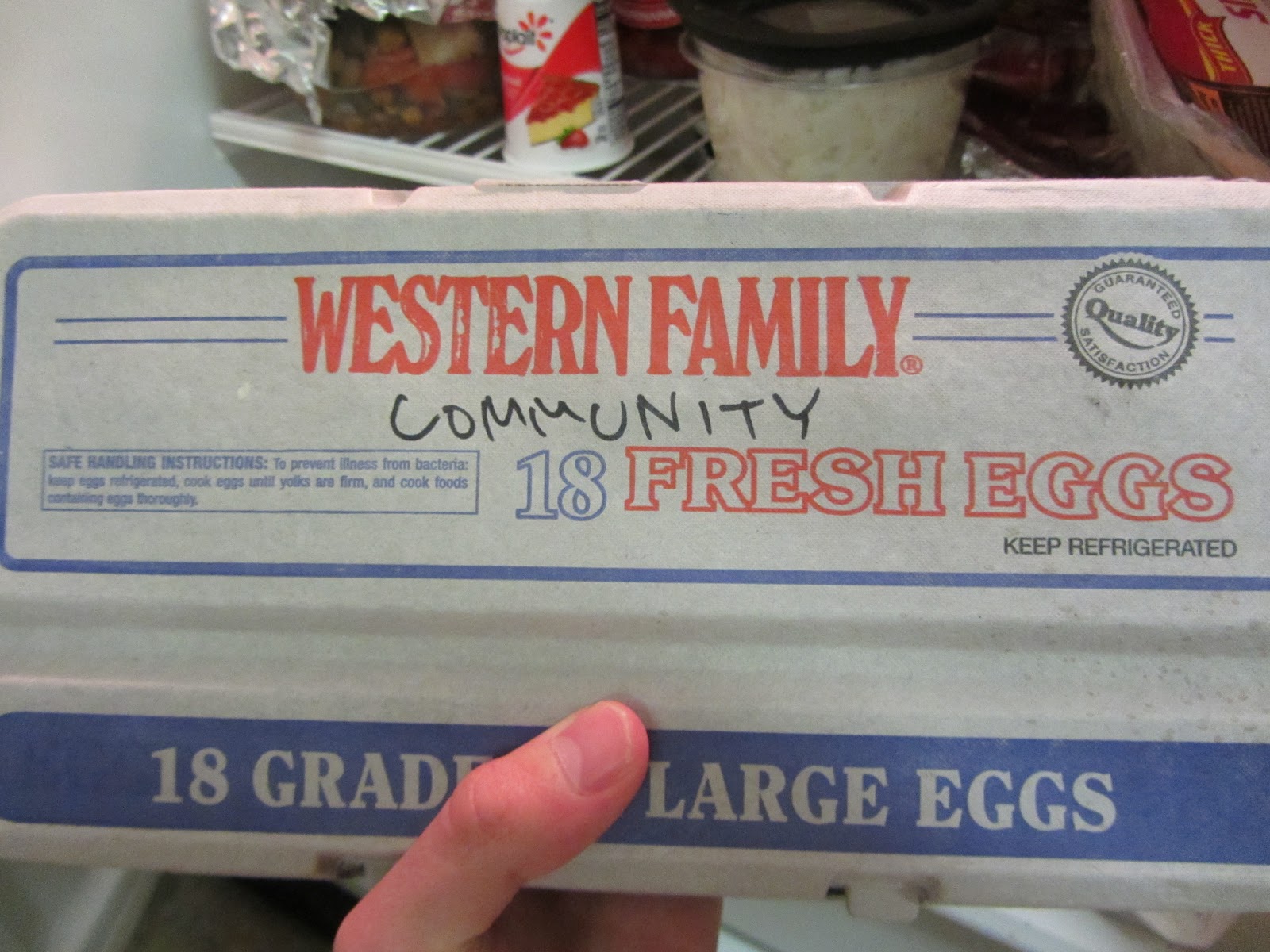 |
| Eggs- 'community food' in dorm 232. |
 |
| Most types of food remain individually owned and labeled. |
The Weekly Stuff Chart yielded some interesting results. Most notably, the amount of milk, eggs and bread consumed skyrocketed. When I served as our first milk man, the dorm got by on 3-1/2 gallons of milk just fine, but by the time Peter had gone for milk a few weeks later, we were barely getting by on 5 gallons. Our first egg-buyer brought 36 eggs to the dorm to last his shift, but it wasn't long before we had managed to consume 108 eggs in a single week. Bread was disappearing by the loaf, and the job of community food purchaser became a burden indeed.
Why did this happen?
Microeconomic theory holds that people will weigh the costs and benefits of their actions when determining what to do. It holds that people are economically rational, meaning that they will arrive at conclusions that maximize their personal advantage.
Suppose I decide to eat eggs. To determine how many eggs I will eat, I measure the marginal benefit and marginal cost of eating eggs. The marginal benefit is the benefit I gain for each additional egg I eat, and the marginal cost is the price I pay for each egg eaten.
The law of diminishing returns states that as I continue to eat eggs, they will gradually give me less benefit. After all, food tastes better when you're hungry, so it stands to reason that it will be less tasty to me as I start to fill up. Furthermore, as I eat eggs I will eventually get sick of them and desire variety, so in that sense they will also become less pleasurable.
Whatever the cost of eating eggs- it isn't going to change, per egg, as you eat more eggs.
This is represented by Figure 1-- a static marginal cost line, and a downward-sloping marginal benefit.
 |
| Fig. 1 |
The thing about eggs is that if I eat one, it's gone. Same goes for milk, if I drink a glass, or bread, if I eat a slice. Thus, if I'm the one buying, the marginal cost of these items is the knowledge that if I want it again, I'm paying for it myself. The more I have to pay, the higher the total cost.
It shouldn't be hard to see then how the concept of community food changes the graph-- marginal cost goes down. After all, if I eat an egg with the knowledge that somebody *else* is replacing it, it's no longer such a big deal. The cost of eating an egg is now essentially zero, a change represented by figure 2.
 |
| Fig. 2 |
As you can see, the quantity consumed has increased drastically, and for a relatively simple reason: if it costs me less to get the same thing, I'm going to get more of it. Note that in each case, the quantity of eggs (or milk or bread) is represented by the point at which the marginal benefit is equal to the marginal cost. This is because, rationally speaking, I'm going to keep eating eggs as long as the benefit outweighs the cost. Since the cost of eating eggs is close to zero in the case that they are community food, it stands to reason that I will continue to eat them until they cease to provide me any benefit at all (e.g. I'm totally sick of them).
Though unseen, this graph displays results that were fully realized by the members of our dorm as time went on. It then begs the question- is there a problem here? After all, what's wrong with eating more eggs and more bread if they're all being eaten?
The answer is yes, there is a problem. Because we're buying and consuming a lot of food that people don't actually want.
Even though the marginal cost *to me* is zero for eating another community egg, *somebody* had to go out and buy that egg, and the cost is imposed on them. When it's the egg man's turn to go out and buy 100 eggs for 8 dollars, only to have many of them be eaten by dorm members who barely want them at all, who end up valuing the lot at 5 dollars, he (the egg man) has performed an action that is of net loss to the dorm. It is rational for him to buy the eggs, because the rest of us have made sure to impose shame at a cost much greater than 8 dollars if he doesn't, but the end result is an irrational waste of resources.
This is a concept that no one else in the dorm fully understands, but the idea that massive community food expenditures like the ones we've been having probably aren't efficient is an idea that's resonating.
Much to the dorm's displeasure, other aspects of the Weekly Stuff chart fared badly as well.
 |
| The typical state of our sink, on a good day. |
 |
| Also a good day. |
Kitchen man rarely did the dishes, and the tables were exactly as messy as before. This is due to a couple problems:
1. The person who uses a dish or leaves out a mess is not the same person who has to clean it, meaning that dorm members have very little incentive to be resourceful about the messes they make.
2. There's only so much we can do as a group to inflict shame. We're not the government, so locking people up in jail or shooting them with a gun is off the table. This means on any given day that kitchen man is a little busy, if spending the time it takes for him to clean the amazing amount of mess six people can create in a kitchen costs more than the shame we can inflict, the messes will not be cleaned.
 |
| "Passable." |
The refrigerator-- though technically the duty of kitchen man to straighten, was often disorganized and at oftentimes a complete mess. This brings to light another issue with community rules, which is that they are often hard to define. A "clean" refrigerator means one thing to someone who came from a house of perfectionists, and something entirely different to he who came from a house of chaos (you know who you are).
It is the nature of community jobs to be done to a bare minimum. Whatever one can get away with to avoid the consequence of shame.
 |
| "Highly questionable." |
When it was suggested that perhaps Kitchen man simply had too much to do, we tried to divert work away from him and encourage a little personal responsibility through the creation of the "community standards" page (shown below).
It details the process by which people are supposed to aid in dish washing and pick up to a certain degree. Kitchen man is still to do most of the work, but everyone should do their part with regard to their own things.

Our system is crumbling.
The Solution
Privatize, privatize, privatize.
I venture that all of our problems stem from "community." The irony stings in knowing that I made the Weekly Stuff chart and now in my lonesome advocate its abolishment, but there are many other changes that need to be made for optimum efficiency in dorm 232.
Let's start with community food, and why we don't need it.
If you'll recall, the initial reasoning behind the institution of community food was:
"We determined that milk, bread and eggs would be consumed by all of us on a weekly basis, so rather than have us each making our own separate runs to the store just down the road, we could have one person do it for all of us."
This turned out to be irrelevant for 2 reasons. Firstly, the store contains a great many products that each one of us uses on a regular basis. Everything from toothpaste to paper is a must-have, and as it turns out, each one of us makes a run about once a week anyway.
Secondly, there is a perfectly good community-less solution that has already manifested itself on multiple occasions: compensation. For one reason or another somebody needs to pick something up but they're too busy to do it, and a quick exchange between them and another guy lying around who does have time ensures a speedy delivery. "Go pick this up for me and I'll pay for your laundry" is perfectly applicable to eggs, or bread, or milk should a dire situation ever arise.
When I most recently suggested we abolish community food, a new concern arose: fridge space.
Milk gallons, the dorm mate reasoned, were both spacey and popular to buy. If each one of us bought a milk gallon every week, we could never hope to fit them all in the space we had. After all, nobody wants to buy half-gallons, since the milk to dollar ratio is significantly worse.
A legitimate complaint, to which I devised a new solution.
Rather than label milk gallons individually, we could *co-own* them. Consider a milk gallon labeled like so:

Of the remaining 2,822 grams of milk left in this gallon, the labeling indicates that I own 822 grams of it, and some Jared owns 2,000. When we purchased this gallon, I must not have needed as much milk. I would have payed him an amount of money relative to the percentage of milk I owned after the purchasing, and whichever one of us picked up the milk from the store would have received a premium from the other.
The following process is then used when I choose to drink from our gallon of milk:

1. Use as much as I want.
2. Weigh the milk gallon when I'm done using it, and make note of how many grams of milk are left.

3. Make a brief calculation to determine how much milk I drank.

4. Adjust the label to reflect how much of the milk in the gallon I now own.
This solves the problem of over-consumption in milk, since the marginal cost for me to drink milk is equal to the marginal cost of buying the milk (I'm the buyer), and also ensures that limited fridge space is conserved for everyone to leave milk there. In fact, since milk consumption would be reduced to reasonable levels, fridge space taken up by milk would be reduced.
The reasoning used here should apply equally to eggs, which can be marked individually. Bread doesn't suffer at all from this problem, for obvious reasons.
When I proposed my solution again, bread was officially removed from the Weekly Stuff chart community food list. Eggs and milk is a work in progress, with complaints on the other side regarding the inefficiency associated with having to mark up eggs and milk so intensely before and after use. It remains obvious that leaving these foods to the community poses a far greater harm, but if any readers can think of a more efficient labeling solution, I'd love to hear it. I'm considering a couple other ideas myself.
Allocating Space and Capital
In dorm 232, as is typical with dorms everywhere, all space, other than the rooms, is treated as "community space." Strangely enough, it isn't even thought of in this manner-- it's just assumed as the way things are. I attribute this to the way people are raised in American households throughout their pre-college education, but there could be other, deeper factors at play. All the same, many problems are solved when this space is owned by individual members of the dorm.
It's worth noting, firstly, that some spaces *aren't* worth distributing to individuals. The hallways, for example, are so infrequently used that they aren't really "scarce." Exactly as often as people desire to use the hallway can they use it, and between the six of us there is never a "traffic jam." Just as there is no price on air, and nobody owns it, there need be no price on hallway use, or ownership thereof.
In dorm 232, as is likely typical of other dorms, there are a dozen significant sources of capital owned by the community.

1. Couch
2. Kitchen table
3. Refrigerator
4. Stove
5. Oven
6. Microwave
7. Kitchen Sink
8. Dishwasher
9. Shower
10. Bathtub
11. Toilet
12. Bathroom Sink
All of these should be owned individually.
Note that they can be divided up in many cases-- no one person has to own the entire kitchen table, and I anticipate that no one person would. If each of us has a strong desire for some table space, and none of us has a great desire for more than a small amount, the table would be divided six ways.
Since we can assume that, in a state of community ownership, each one of us owns each item of capital to an equal degree, simply bid off each item-- the highest bidder gains ownership and pays the rest of the community an equal portion of the determined price.
For example, I could call a price of $10 for the couch. If you value it more highly then 10, you bet $11. When someone finally ends with the highest bet of $25, he pays each of us 5-- his dorm mates-- $5 dollars, and then obtains ownership of the couch.
Some items, like the table, can be divided six ways right from the start (assuming 6 random portions of table are essentially equal in value), and then if one desires more table space he can buy it off someone who desires the table space less, if such a person exists.
Keep in mind that if I own the couch, I have an incentive to allow other people to use it, for a fee, during the times I'm not using it. So resources are unlikely to go to waste.
The kitchen sink would never be loaded with dishes, because you can't leave your stuff on someone else's property. To use the sink and dishwasher you would pay a minor fee, and then return it to cabinet space that you own.
Refrigerator space would be used wisely because you wouldn't have much of it, and, if you could fit the stuff you have in less space, you could sell of the unused space to someone who wants more and make money.
This is the way in which problems are solved.
Subscribe to:
Posts (Atom)